Murmuration from Sophie Windsor Clive on Vimeo.
Sunday, 11 December 2011


Wednesday, 23 November 2011
Banality of Evil
.

When I watched the YouTube video of Pepper-spray Lt. John Pike angrily shaking his can of Fizz in the face of peacefully protesting kids, and blasting them with his toxic orange hate as though they were lice, I though this guy couldn’t be a more wonderfully fitting parody of a fat fascist pig if he tried. He has so much of the cartoon slapstick villain in his plodding rotundity, is so thuggishly dishonourable in his loathsome conduct, the motto on his crest must surely read “Banality of Evil” or maybe some equally trite cliché of the Chief Wiggum variety.
The mentality of the UC-Davis goon squad was so malodorous of a white-trash American attitude, it was surreal to watch, and fitting to hear the University’s Chief of Police claiming right of defence - that her officers, (videoed from every angle vigorously pepper-spraying peacefully seated protesters), had in fact been surrounded by threatening students, couldn’t find an exit, and just wanted to go home.
When pursuing a car along a highway Chief Wiggum in the T.V show 'The Simpsons' was asked to describe his location, and replied "I'm on a road, looks to be asphalt--aw jeez, trees, shrubs--uh, I'm directly under the earth's Sun...now." When asked to explain her authorization of police force on UC-Davis students, Chancellor Katehi explained that she had ordered police to disperse protestors with violence if necessary, in the interests of "student safety".
In this case, life parodies 'The Simpsons' or some tweaked American horror-comedy where the disorientated and subjugated psyche of a trash T.V. culture, hopelessly lost for want of a moral compass, accidentally chooses its destroyer, (as in the Ghostbusters movie) which then takes corporeal form and lurches into action, attacking freedoms of speech, and assembly in the form of a John Pike Stay-Puft Marshmellow-Man macabre.
But the blaim for an erosion of democratic freedoms can't be foisted upon the gormless John Pike, or the cowed Chancellor, no doubt aligning herself obediently with a political climate of authoritarianism as dictated from above, but must be shared by a culture of apathy and indifference, a population of pacified individuals to ready to to relinquish their rights voluntarily, to ready to meekly acquiesce, as Rosa Luxemburg put it “Those who do not move, do not notice their chains.” As always it is the unsullied idealism of youth where the spirit of resistance still finds an ardent voice, calling the sleepers to awaken.

Glenn Greenwald explains the sinister mechanism of mindless police brutality in his article 'on the roots of the UC-Davis pepper-spraying'
Despite all the rights of free speech and assembly flamboyantly guaranteed by the U.S. Constitution, the reality is that punishing the exercise of those rights with police force and state violence has been the reflexive response in America for quite some time. As Franke-Ruta put it, “America has a very long history of protests that meet with excessive or violent response, most vividly recorded in the second half of the 20th century.”
The intent and effect of such abuse is that it renders those guaranteed freedoms meaningless. If a population becomes bullied or intimidated out of exercising rights offered on paper, those rights effectively cease to exist. Every time the citizenry watches peaceful protesters getting pepper-sprayed — or hears that an Occupy protester suffered brain damage and almost died after being shot in the skull with a rubber bullet — many become increasingly fearful of participating in this citizen movement, and also become fearful in general of exercising their rights in a way that is bothersome or threatening to those in power. That’s a natural response, and it’s exactly what the climate of fear imposed by all abusive police state actions is intended to achieve: to coerce citizens to “decide” on their own to be passive and compliant — to refrain from exercising their rights — out of fear of what will happen if they don’t.
The genius of this approach is how insidious its effects are: because the rights continue to be offered on paper, the citizenry continues to believe it is free. They believe that they are free to do everything they choose to do, because they have been “persuaded” — through fear and intimidation — to passively accept the status quo. As Rosa Luxemburg so perfectly put it: “Those who do not move, do not notice their chains.” Someone who sits at home and never protests or effectively challenges power factions will not realize that their rights of speech and assembly have been effectively eroded because they never seek to exercise those rights; it’s only when we see steadfast, courageous resistance from the likes of these UC-Davis students is this erosion of rights manifest.
The Guardian: The shocking truth about the crackdown on Occupy Naomi Wolf
.


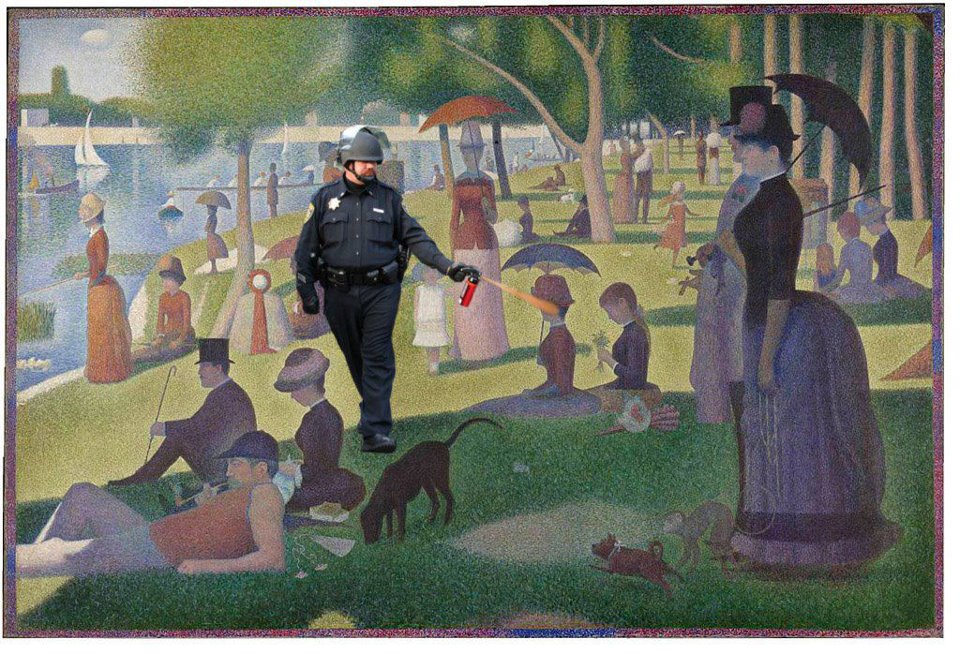
When I watched the YouTube video of Pepper-spray Lt. John Pike angrily shaking his can of Fizz in the face of peacefully protesting kids, and blasting them with his toxic orange hate as though they were lice, I though this guy couldn’t be a more wonderfully fitting parody of a fat fascist pig if he tried. He has so much of the cartoon slapstick villain in his plodding rotundity, is so thuggishly dishonourable in his loathsome conduct, the motto on his crest must surely read “Banality of Evil” or maybe some equally trite cliché of the Chief Wiggum variety.
The mentality of the UC-Davis goon squad was so malodorous of a white-trash American attitude, it was surreal to watch, and fitting to hear the University’s Chief of Police claiming right of defence - that her officers, (videoed from every angle vigorously pepper-spraying peacefully seated protesters), had in fact been surrounded by threatening students, couldn’t find an exit, and just wanted to go home.
When pursuing a car along a highway Chief Wiggum in the T.V show 'The Simpsons' was asked to describe his location, and replied "I'm on a road, looks to be asphalt--aw jeez, trees, shrubs--uh, I'm directly under the earth's Sun...now." When asked to explain her authorization of police force on UC-Davis students, Chancellor Katehi explained that she had ordered police to disperse protestors with violence if necessary, in the interests of "student safety".
In this case, life parodies 'The Simpsons' or some tweaked American horror-comedy where the disorientated and subjugated psyche of a trash T.V. culture, hopelessly lost for want of a moral compass, accidentally chooses its destroyer, (as in the Ghostbusters movie) which then takes corporeal form and lurches into action, attacking freedoms of speech, and assembly in the form of a John Pike Stay-Puft Marshmellow-Man macabre.
But the blaim for an erosion of democratic freedoms can't be foisted upon the gormless John Pike, or the cowed Chancellor, no doubt aligning herself obediently with a political climate of authoritarianism as dictated from above, but must be shared by a culture of apathy and indifference, a population of pacified individuals to ready to to relinquish their rights voluntarily, to ready to meekly acquiesce, as Rosa Luxemburg put it “Those who do not move, do not notice their chains.” As always it is the unsullied idealism of youth where the spirit of resistance still finds an ardent voice, calling the sleepers to awaken.

Glenn Greenwald explains the sinister mechanism of mindless police brutality in his article 'on the roots of the UC-Davis pepper-spraying'
Despite all the rights of free speech and assembly flamboyantly guaranteed by the U.S. Constitution, the reality is that punishing the exercise of those rights with police force and state violence has been the reflexive response in America for quite some time. As Franke-Ruta put it, “America has a very long history of protests that meet with excessive or violent response, most vividly recorded in the second half of the 20th century.”
The intent and effect of such abuse is that it renders those guaranteed freedoms meaningless. If a population becomes bullied or intimidated out of exercising rights offered on paper, those rights effectively cease to exist. Every time the citizenry watches peaceful protesters getting pepper-sprayed — or hears that an Occupy protester suffered brain damage and almost died after being shot in the skull with a rubber bullet — many become increasingly fearful of participating in this citizen movement, and also become fearful in general of exercising their rights in a way that is bothersome or threatening to those in power. That’s a natural response, and it’s exactly what the climate of fear imposed by all abusive police state actions is intended to achieve: to coerce citizens to “decide” on their own to be passive and compliant — to refrain from exercising their rights — out of fear of what will happen if they don’t.
The genius of this approach is how insidious its effects are: because the rights continue to be offered on paper, the citizenry continues to believe it is free. They believe that they are free to do everything they choose to do, because they have been “persuaded” — through fear and intimidation — to passively accept the status quo. As Rosa Luxemburg so perfectly put it: “Those who do not move, do not notice their chains.” Someone who sits at home and never protests or effectively challenges power factions will not realize that their rights of speech and assembly have been effectively eroded because they never seek to exercise those rights; it’s only when we see steadfast, courageous resistance from the likes of these UC-Davis students is this erosion of rights manifest.
The Guardian: The shocking truth about the crackdown on Occupy Naomi Wolf
.


Monday, 14 November 2011
Sunday, 23 October 2011
Thursday, 20 October 2011
Response to Corexit 9500 in the Bay of Plenty
The chemical dispersant Corexit 9500, used on the Rena oil spill in the Bay of Plenty, may have been shelved for now but it is still part of our Government’s tool kit, and there is no indication that it won’t be used again. Carys Mitchelmore (Cited in Raloff, 2011) of the University of Maryland's Center for Environmental Science says the jury is still out on the efficacy of dispersants, and that it remains unclear if they help degrade oil. But more importantly why was this toxic dispersant used considering the limited amount of scientific research on the potentially adverse, and long-term effects on human health and the environment. EPA Administrator Lisa Jackson (cited in McDonnell, 2011) has conceded that the long-term effects of dispersants on aquatic life are unknown. Given that environmentally friendly alternatives exist, keeping experimentation in the lab seems like wise advice. But fools rush in where angels fear to tread, and the fragile eco system of the Bay of Plenty has now become a testing ground for Corexit.
A recently released study of Corexit 9500 dispersant by Scientists from Woods Hole Oceanographic Institution (Massachusetts, USA), the University of California – Santa Barbara (California, USA), and Stanford University (California) published “Fate of Dispersants Associated with the Deepwater Horizon Oil Spill” in the 26 January 2011 Environmental Science and Technology “Articles ASAP” online. The subsequent report notes that; "Research focused on the core ingredient of Corexit, the anionic surfactant dioctyl sodium sulfosuccinate (DOSS)," and that (DOSS) "underwent negligible or slow rates of biodegradation in the effected waters." Elizabeth Kujawinski (cited in Oil Spill Intelligence Report, 2011) of the Woods Hole Oceanographic Institution says this is bad news, and that Corexit 9500 didn’t go away as quickly as people had thought it might. The report concludes that the deep waters of the Gulf of Mexico will likely suffer long-term exposure to (DOSS), but because of a lack of toxicity studies, the impact of the dispersant on marine ecology remains unclear.
Charles W Schmidt (2010) of the National Institute of Environmental Health Sciences (USA), explains the action of dispersant on oil "Dispersants change the oil's physical and chemical properties, splitting it into tiny droplets that measure roughly 10 microns in diameter (naturally dispersed oil droplets are about 10 times larger)." Acording to Schmidt, dispersed oil droplets dont go away but instead "get pulled (or "entrained") into the water column." Carys Mitchelmore (cited in Schmidt, 2010) adds that as a result "Zooplankton mistake oil droplets for food and that's a dangerous scenario because zooplankton are crucial to the marine food web." Damage microbial ecology says Mitchelmore and the consequences spiral upwards.
Common sense dictates that the many endangered species of the Bay of Plenty should not be treated as lab rats, and so it is deeply concerning that the use of Corexit was our Governments first choice management strategy for this disaster. Assuming that our politicians do not suffer from cognitive impairment, reasons other than environmental concern should be considered when rationalising their decision to spray a fragile marine environment with a potentially dangerous dispersant. Sadly, our Governments heavy lobbying to attract the international oil industry to New Zealand waters provides a more likely motive for their rush to adopt shoddy oil industry standards. Environment Minister Nick Smith has said that Corexit is "no more toxic than dishwashing liquid," despite cautionary warnings from the scientific community who have expressed significant doubts about the efficacy of dispersants and there safety. Nick Smith's work output over the last three years has involved nothing to do with implementing protective and preventative measures for a situation like this (or similar to Deepwater Horizon) should the proposed Petrobras explorations go ahead. He has instead spent that time finding ways to legislate the corporate sectors out of their ETS obligations. Nick Smith’s endorsement of Corexit is a worrying indication of where his allegiances lie, corporate profiteering at the expense of health, safety, and the environment.
An EPA Whistleblower, Hugh Kaufman (Democracynow.org, 2010), has explained why dispersants like Corexit were used in the Gulf of Mexico, and why the use of Corexit is the favoured oil spill management strategy for big business. “Corexit is one of a number of dispersants, that are toxic, that are used to atomize the oil and force it down the water column so that it’s invisible to the eye. In this case these dispersants were used in massive quantities, almost two million gallons so far, to hide the magnitude of the spill and save BP money. And the government — both EPA, NOAA, etc. — have been sock puppets for BP in this cover-up. Now, by hiding the amount of spill BP is saving hundreds of millions, if not billions of dollars in fines, and so, from day one, there was tremendous economic incentive to use these dispersants to hide the magnitude of the gusher.”
The clean up of the Rena oil spill is likely to create a precedent for how future spills are managed in New Zealand. If the public are not fastidious in their questioning of our Governments actions and motives, the future for New Zealand's marine environment looks anything but bright.
References:
'Dispersants Long-Lived, But Effects Unclear. (Cover story)' 2011, Oil Spill Intelligence Report, 34, 8, p. 1, Academic Search Premier, EBSCOhost, viewed 24 October 2011.
Kaufman, Hugh (2010) Democracynow.org, Available: http://www.democracynow.org/2010/7/20/epa_whistleblower_accuses_agency_of_covering
Kujawinski, E, Soule, M, Valentine, D, Boysen, A, Longnecker, K, & Redmond, M (2011), 'Fate of Dispersants Associated with the Deepwater Horizon Oil Spill', Environmental Science & Technology, 45, 4, pp. 1298-1306, Academic Search Premier, EBSCOhost, viewed 24 October 2011.
McDonnell, D. (2011) Lawsuit Launched to Force EPA to Study Oil-dispersant Impacts on Endangered Wildlife. Targeted News Service, April 18, http://www.proquest.com/ (accessed October 24, 2011).
Raloff, Janet. (2011) Dispersants persisted after BP spill
Science News. Washington:Feb 26, 2011. Vol. 179, Iss. 5, p. 8 (1 pp.)
Schmidt, Charles W. (2010) BETWEEN THE DEVIL AND THE DEEP BLUE SEA DISPERSANTS IN THE GULF OF MEXICO. Environmental Health Perspectives. Research Triangle Park:Aug 2010. Vol. 118, Iss. 8, p. a338-44 (7 pp.)
Hugh Kaufman on Radio New Zealand 11.11.11 discussing the dangers of Corexit.
New Zealand Herald Rena: Oil clean-up chemical worries Greenpeace
A recently released study of Corexit 9500 dispersant by Scientists from Woods Hole Oceanographic Institution (Massachusetts, USA), the University of California – Santa Barbara (California, USA), and Stanford University (California) published “Fate of Dispersants Associated with the Deepwater Horizon Oil Spill” in the 26 January 2011 Environmental Science and Technology “Articles ASAP” online. The subsequent report notes that; "Research focused on the core ingredient of Corexit, the anionic surfactant dioctyl sodium sulfosuccinate (DOSS)," and that (DOSS) "underwent negligible or slow rates of biodegradation in the effected waters." Elizabeth Kujawinski (cited in Oil Spill Intelligence Report, 2011) of the Woods Hole Oceanographic Institution says this is bad news, and that Corexit 9500 didn’t go away as quickly as people had thought it might. The report concludes that the deep waters of the Gulf of Mexico will likely suffer long-term exposure to (DOSS), but because of a lack of toxicity studies, the impact of the dispersant on marine ecology remains unclear.
Charles W Schmidt (2010) of the National Institute of Environmental Health Sciences (USA), explains the action of dispersant on oil "Dispersants change the oil's physical and chemical properties, splitting it into tiny droplets that measure roughly 10 microns in diameter (naturally dispersed oil droplets are about 10 times larger)." Acording to Schmidt, dispersed oil droplets dont go away but instead "get pulled (or "entrained") into the water column." Carys Mitchelmore (cited in Schmidt, 2010) adds that as a result "Zooplankton mistake oil droplets for food and that's a dangerous scenario because zooplankton are crucial to the marine food web." Damage microbial ecology says Mitchelmore and the consequences spiral upwards.
Common sense dictates that the many endangered species of the Bay of Plenty should not be treated as lab rats, and so it is deeply concerning that the use of Corexit was our Governments first choice management strategy for this disaster. Assuming that our politicians do not suffer from cognitive impairment, reasons other than environmental concern should be considered when rationalising their decision to spray a fragile marine environment with a potentially dangerous dispersant. Sadly, our Governments heavy lobbying to attract the international oil industry to New Zealand waters provides a more likely motive for their rush to adopt shoddy oil industry standards. Environment Minister Nick Smith has said that Corexit is "no more toxic than dishwashing liquid," despite cautionary warnings from the scientific community who have expressed significant doubts about the efficacy of dispersants and there safety. Nick Smith's work output over the last three years has involved nothing to do with implementing protective and preventative measures for a situation like this (or similar to Deepwater Horizon) should the proposed Petrobras explorations go ahead. He has instead spent that time finding ways to legislate the corporate sectors out of their ETS obligations. Nick Smith’s endorsement of Corexit is a worrying indication of where his allegiances lie, corporate profiteering at the expense of health, safety, and the environment.
An EPA Whistleblower, Hugh Kaufman (Democracynow.org, 2010), has explained why dispersants like Corexit were used in the Gulf of Mexico, and why the use of Corexit is the favoured oil spill management strategy for big business. “Corexit is one of a number of dispersants, that are toxic, that are used to atomize the oil and force it down the water column so that it’s invisible to the eye. In this case these dispersants were used in massive quantities, almost two million gallons so far, to hide the magnitude of the spill and save BP money. And the government — both EPA, NOAA, etc. — have been sock puppets for BP in this cover-up. Now, by hiding the amount of spill BP is saving hundreds of millions, if not billions of dollars in fines, and so, from day one, there was tremendous economic incentive to use these dispersants to hide the magnitude of the gusher.”
The clean up of the Rena oil spill is likely to create a precedent for how future spills are managed in New Zealand. If the public are not fastidious in their questioning of our Governments actions and motives, the future for New Zealand's marine environment looks anything but bright.
References:
'Dispersants Long-Lived, But Effects Unclear. (Cover story)' 2011, Oil Spill Intelligence Report, 34, 8, p. 1, Academic Search Premier, EBSCOhost, viewed 24 October 2011.
Kaufman, Hugh (2010) Democracynow.org, Available: http://www.democracynow.org/2010/7/20/epa_whistleblower_accuses_agency_of_covering
Kujawinski, E, Soule, M, Valentine, D, Boysen, A, Longnecker, K, & Redmond, M (2011), 'Fate of Dispersants Associated with the Deepwater Horizon Oil Spill', Environmental Science & Technology, 45, 4, pp. 1298-1306, Academic Search Premier, EBSCOhost, viewed 24 October 2011.
McDonnell, D. (2011) Lawsuit Launched to Force EPA to Study Oil-dispersant Impacts on Endangered Wildlife. Targeted News Service, April 18, http://www.proquest.com/ (accessed October 24, 2011).
Raloff, Janet. (2011) Dispersants persisted after BP spill
Science News. Washington:Feb 26, 2011. Vol. 179, Iss. 5, p. 8 (1 pp.)
Schmidt, Charles W. (2010) BETWEEN THE DEVIL AND THE DEEP BLUE SEA DISPERSANTS IN THE GULF OF MEXICO. Environmental Health Perspectives. Research Triangle Park:Aug 2010. Vol. 118, Iss. 8, p. a338-44 (7 pp.)
Hugh Kaufman on Radio New Zealand 11.11.11 discussing the dangers of Corexit.
New Zealand Herald Rena: Oil clean-up chemical worries Greenpeace
Saturday, 25 June 2011
Tuesday, 31 May 2011
Surf travel in Sumbawa
.


When the flat spell entered its forth day I was ready to go exploring. It didn’t worry me that I had never ridden a motorbike before. Mr Jack provided patient driving instruction and for a small fee, a few days use of his Honda. After a couple of incident free circuits around the compound I was confident I could stay upright, and stop if needed. Driving down the long dusty road away from Fat Ma’s surf camp towards the looming jungle, I don’t recall registering anything more than a rush of adrenaline as I opened the throttle, and the dark Sumbawan jungle closed in around me. Had I considered the potential dangers of leaving the pampered cultural quarantine of the surf camp, and of venturing alone into the unknown hazards of a impoverished Muslim land of which I new almost nothing, then maybe the events of the day would have transpired differently. But the excitement of the wind rushing through my hair, and the thrill of riding out into the unknown, eclipsed any considerations that a more seasoned traveller would have given for precautionary measures, like taking a map, or at the very least wearing a helmet. I guess you don’t know what you don’t know. Wisdom comes at the behest of experience, and when you don’t have wisdom or experience, then the innocence and vigour of youth becomes your best ally, you throw the dice, and luck or fortune measures your fate.

Sumbawan roads are made for motorbikes. All one needs to do is adopt a happy slalom rhythm. In this fashion numerous hazards can be easily negotiated, shrubs growing out of the cracked patchwork of tarmac, yawning pot holes, and large basking snakes all whiz by in a dreamy rhapsody. I remember families of sunbathing monkeys scurrying off the road, swinging lazily up into the podocarp forest, and chattering noisily as I turned onto stretches of meandering dirt trail, motoring on beneath high arching bush clad mountains, through swampy rice fields, and swirling clouds of brightly coloured butterflies. The remoteness, isolation, and share beauty of the place was intoxicating. For a few miles, I followed the coast on a narrow road cut into volcanic cliffs that dropped steeply into the bright turquoise ocean. I stopped to drink in the dazzling view of the liquid amber reef, sliding into the deep swirling depths of an unknown horizon. I was high on the thrill of exploring this faraway prehistoric paradise, populated it seemed, only by me and the fiercely burning sun.

I was greeted at the first village I entered by rapturous salutations from young children who franticly pursued me down the road, joyfully calling out ‘hello Mister’ in gleeful choruses as though I were the veritable pied piper of Sumbawa. In one village I was stopped and surrounded by a sea of delighted young faces, mouths agape, all staring in wonder at my white skinned strangeness. As I ventured further from the well travelled tourist route that connects the ferry port of Bima to the surf camps of Hu’u, the increasingly ecstatic greetings I received from children became a measure of how far I was departing from the beaten trail, until finally there was no more ‘hello mister’, just excited whoppings and hollerings.
I stopped to photograph some young boys idling at the waters edge on a bleached white sand beach. They looked at me with expressions of perplexity as I periodically gazed at them through the viewfinder. Walking around them in circles to get the most picturesque angle, I crouched down on one knee, and after gazing at the sun, and checking my exposure levels, I noticed their bewilderment was bordering on fear as they deferred to each other in nervous whispers. I smiled and greeted them in Bahasa Bima "Assalam mualaikum" to which they erupted with roars of delight, rushing foward to run their hands through my hair and over my skin before I could take my photograph. I wondered what story they might later tell their friends, of their rare encounter with a crazy white man and his most peculiar traditional greeting.

The villages I passed through were mostly comprised of rickety old huts elevated off the ground on stilts, all crooked angles and crisscrossed ill fitted happenstance. I latter learned that an abode like this commonly serves to accommodate families of twelve or more, with the head of the family espoused to numerous wives and supporting children to all of them. The Sumbawans who populate these villages live ruff, frugal agricultural lives closely intertwined with their family members and communities. Their possession are few, and their opportunities for a life beyond the poverty and subsistence of their local villages are limited. Many of the island’s residents are at risk of starvation when crops fail due to a lack of rainfall and unlike Bali, and their other Indonesian Island neighbours, tourism in Sambawa is still very embryonic, with just a few surf camps making up the totality of the industry.

Given the enormous relative wealth and opportunities to which westerners are privileged, and the jet setting, and comparatively luxurious existence of the surf camp beach boys, it is not surprising that dark elements sometimes enter the cultural mix. I wasn’t completely ignorant of the jealousies that can be aroused by difference, or the extremes of poverty that can sometimes compel violent and criminal behaviour. I had heard a few horror stories over the years, of muggings, and of night time robberies descending into full blown machete assaults and dismemberment. Such stories can be heard throughout the surf camps of Indo, usually told with practiced embellishment by a hard charging, knarled, and weathered old surfer, as he saviours his evening Bintang.

Some of the more horrific surf yarns I had heard were delivered, like board riding itself, with the flair and relish of a studied art. A young shredding hotshot with a polished repertoire of flamboyant manoeuvres just can’t beat a salty old dog for a surf story. And because new arrivals to increasingly crowded surf spots are competing for the limited waves on offer, the aim of these stories is often to strategically undermine the confidence of the other. The trick is to push your target beyond the bounds of his incredulity, and as with surfing, timing is essential. One mustn’t rush any hyperbolic embellishments. If your story doesn’t flow harmoniously with the suspension of his disbelief, you’ve lost him. A studied surf dog might begin by arousing the curiosity of his muse in a disinterested sought of way, perhaps throwing off some local lingo he wont understand, and then sharing a few knowing nods and wry smiles with an accomplice. In this way tried hands feel out the vulnerability of the new arrival, measuring the greenness of his experience, given away despite himself by a widening of the eyes as he listens in on an exchange of esoteric knowledge against which he is being carefully measured. The initial probes are best followed with a teaser like “remember unfortunate young Wiley”. In this fashion older surfers pass the evenings, sewing the seeds of fear and doubt in young minds, which ultimately translates into more waves for them the next day as the poor wretch has his sleep ruined by the prowling intrusions of machete wielding desperados, and paddles out the next morning, not to early, to sit wide, clinging nervously to the shoulder, his mind haunted by horror visions of dry reef dismemberment. However, the stories aren’t all histrionics and hyperbole, and it pays to listen to the experiences of your fellow travellers, because jokers and glass blowers aside, the dangers are quite real.

I was about to experience first hand one of the most threatening and volatile situations Sumbawa can serve up on land as I motored lazily through her breathtaking scenery. I had been savouring each stretch of new road with relish, until my hunger for the open horizon began to press up against a nagging cautionary voice, quiet at first, and then more demanding as the heat of the day began to wane and the shadows of the jungle stretched long and roping across my path. At first I noticed stutters in the bikes engine that seemed to rattle out a cautionary warning Im sure I hadn’t heard earlier. I certainly am an old bike, the clanking noises seemed to intone. And then on approach some potholes appeared to grow more craterous, wider and toothier, as they opened up out of the shadows. And I thought, gosh it sure would be easy to puncture a tire in one of those, and then I hit one hard and jarring, and the bike stumbled out the other side feeling a little more fragile, if not stuttering more uneasliy, and I heard a voice say, mechanical failure this far from the surf camp wouldn’t be much fun, and then another voice said, you certainly have come a long way, do you think you can find your way back? These thoughts crept up on me slowly at first until they reached their zenith, stopping me dead in the middle of the road, and I watched an almost visible change sweep across the surrounding landscape as though a cloud had blotted out the sun. I had stretched the umbilical chord of my safety right up to breaking point, and the most unsavoury imaginings began tumbling through my mind, ominous portents of the heavy experience that was about to unload on me.

I’m a heck of a long way from Fat Ma's and I can’t say for sure I can find my way back. This Island is a malaria red zone, and are those swirling flies gathering in the shades of the jungle mosquitoes? To be sure, I have no protective clothing to shield me from their bite, and no repellent! At such moments our mind tends to fixate on the most unsavoury scenes, of a Japanese surfer the week before, pale and moaning in the grips of a malarial fever, being stretchered into a waiting van and driven hurriedly away, or the hardy Sumbawan cook at Fat Ma's who dropped dead one evening over his Nasi Gorang, we were later reassured it was not the food, but Maleria that had killed him!
The sun was dropping low in the sky as I set off in the opposite direction, and looking hopefully at the fuel gage I had the chilling feeling that it hadn’t moved in the last hour! If that is the case, I thought, then I can't afford to miss a turn, but surely my mind is playing tricks on me! Just how strong was that marijuana I smoked with Mr Jack?! These are troubling thoughts which rush upon a man exposed and vulnerable, uncertain if he should take the left hand trail, or the right, perilously low on gas, and anxiously surveying the vast lonely horizons of a third world Muslim country of which he knows almost nothing!
I wasn’t gripped by fear so much as a sharp and urgent immediacy, tempered by the awareness that although I had pushed my safety right up against the edge of potential calamity, there was no immediate problem. All I had to do was to ease that old bike home, watching closely for the familiar landmarks and turnings on the network of dirt trails that would lead me back to Fat Ma's, and as each familiar Mountain and rice field rolled by I felt an ebbing of my anxiety.

It was dusk and I had no cares left for anything more than the rewards of a hot meal and a cold Bintang when I finally reached the village of Hu’u after a long and full day, just twenty minutes shy of Fat Ma’s surf camp. I eased off on the throttle, weaving through the numerous locals gathered in the street, including dogs, chickens, and cattle. It is an end of day custom in villages that have no other means of entertainment, no TV or radio, or even any power, no books, or any of the amenities we take for granted in developed countries, for people to gather together in the evenings and share each others company. A tractor driven by a boy not older than twelve, carrying numerous other children as passengers, approached me out of the crowd and I slowed, tooting my horn and swerving to the shoulder. The accident that followed, and the subsequent events that were to play out over the following anxious weeks, are forever burnt into my memory, and looking back now I can see the beginnings of the whole unhappy drama unfolding in slow motion.

The tractor turned violently at right angles directly into my path, and I swerved, only to feel the bike sliding out from under me. Kicking free, tumbling and sliding on my hip over loose gravel I watched horrified as Mr Jack’s Honda disappeared under its rearing front wheels, which lurched and grinded to a teetering halt almost on top of me! I lay stunned in the dust, and as I looked up at the pile of twisted metal that so easily could have been my body, I experienced a moment of disconnected numbness, and the thought flashed through my mind that potentially my injuries could be serious. Slowly I moved my limbs, and to my great relief, found myself rising up off the ground, breathing deeply, and miraculously unscathed, but the reel trouble was only just beginning to brew.
The accident had been witnessed by half the street it seemed, and as I shakily dusted myself off, feeling for any fractures, and scanning for blood, concerned villagers who were arriving at the crash scene from every direction, began enthusiastically joining me in squeezing and manipulating my limbs, all giving me the unreserved benefits of their chiropractic expertise. They talked excitedly amongst themselves as some ran their hands vigorously up and down my legs, and others rubbed eagerly on my arms. Despite my thanks, and my best efforts to reassure people I was okay, more and more came. I was soon surrounded on all sides by quite a mob, I guessed 40 or more villagers had gathered just moments after the accident, and as I looked out over the top of their diminutive frames, I could see that thick and fast still more were coming, in fact they were running, all aroused by the cacophony of noise and activity being generated by the expanding crowd, and eager to participate in the fun. I couldn’t understand what was being said, but it seemed that my wellbeing was no longer the focus of attention, instead everybody was talking all at once, and some were shouting!

The tractor continued on its merry way while Mr Jack's motorbike disappeared amongst the jostling crowd, the mood of which was deteriorating quickly as several heated arguments began to escalate in volume and volatility, exciting still more hecklers to join in the fray. More worryingly, the massaging of my arms that had begun with therapeutic intent, began to assume the more troubling characteristics of a restraining hold. And in the fading light I feared an imminent evening strafing by Mosquitos would soon find me defenseless! I felt as though I were caught in the grips of a nasty rip, being pulled slowly and surely into the impact zone of a heavy situation. I knew there could be no fighting, my best chance was to stay calm, alert, and watch for an opening.
An angry young man was reaching the climax of an emotional testimony, and suddenly I was in the dock, and looking out at a stacked jury who were returning cold, dark, and accusatory stares, and as the gallery grew more bipartisan I was sure a punitive sentence would soon be forthcoming. And then I heard a voice at my shoulder, “Hello Mister, I am Imal, brother of Mr Jack. Things look bad for you Mister! Come now! On my bike I take you surf camp. Please, we leave now Mister!

There was a moment of confusion and indecision amongst the mob as I fended off a few grasping hands and leaped onto the back of Imal’s waiting bike. There were angry shouts of "Ho hey yeh!" from bystanders who rushed at us, grabbing and snatching as we broke free and accelerated away. My relief was short lived. We were soon travelling at such a speed, I started to wonder if I might have been safer with the angry mob. I shouted at Imal "Wooo, slow down!" But instead Imal accelerated to such a frantic pace that it was impossible to dodge all the potholes. When we hit them jolts rippled through my entire frame so that I could feel the throbbing in every bruised limb, and some we hit so hard it was all I could do to stay on the bike. I felt like the ill-fated fall guy in an old silent movie, it was just to horrible and over dramitised to be believed! And then I heard engine noise behind us. I glanced back and counted half a dozen bikes roaring up in hot pursuit, some with one rider, others in tandem. They were closing on us, and as they drew near I could see that they were brandishing machetes, pointing at me and waggling their blades ostentasiously, all sneering and bristling with exaggerated indignation. Leaning close into Imal's back I shouted into the wind "What the fuck is going on! Hey man, what the fuck is happening!"
“They say you damage tractor. They want you pay money now!”
They were almost on us as we swung in through the front gates of Fat Ma's surf camp, with Imal letting out victorious whoops. "They not follow here!" He shouted triumphantly.
And so it was a sadder and a wizer man who walked slowly and shakily into Fat Ma's restuarant, and slumped down before the inquiring gaze of his fellow surfers, silent and stunned, contemplating the frightening implications of a more lively cultural experience than he had bargained for!


When the flat spell entered its forth day I was ready to go exploring. It didn’t worry me that I had never ridden a motorbike before. Mr Jack provided patient driving instruction and for a small fee, a few days use of his Honda. After a couple of incident free circuits around the compound I was confident I could stay upright, and stop if needed. Driving down the long dusty road away from Fat Ma’s surf camp towards the looming jungle, I don’t recall registering anything more than a rush of adrenaline as I opened the throttle, and the dark Sumbawan jungle closed in around me. Had I considered the potential dangers of leaving the pampered cultural quarantine of the surf camp, and of venturing alone into the unknown hazards of a impoverished Muslim land of which I new almost nothing, then maybe the events of the day would have transpired differently. But the excitement of the wind rushing through my hair, and the thrill of riding out into the unknown, eclipsed any considerations that a more seasoned traveller would have given for precautionary measures, like taking a map, or at the very least wearing a helmet. I guess you don’t know what you don’t know. Wisdom comes at the behest of experience, and when you don’t have wisdom or experience, then the innocence and vigour of youth becomes your best ally, you throw the dice, and luck or fortune measures your fate.
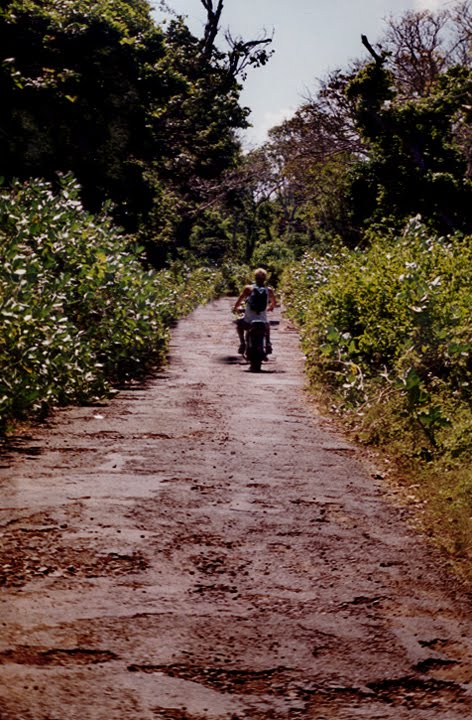
Sumbawan roads are made for motorbikes. All one needs to do is adopt a happy slalom rhythm. In this fashion numerous hazards can be easily negotiated, shrubs growing out of the cracked patchwork of tarmac, yawning pot holes, and large basking snakes all whiz by in a dreamy rhapsody. I remember families of sunbathing monkeys scurrying off the road, swinging lazily up into the podocarp forest, and chattering noisily as I turned onto stretches of meandering dirt trail, motoring on beneath high arching bush clad mountains, through swampy rice fields, and swirling clouds of brightly coloured butterflies. The remoteness, isolation, and share beauty of the place was intoxicating. For a few miles, I followed the coast on a narrow road cut into volcanic cliffs that dropped steeply into the bright turquoise ocean. I stopped to drink in the dazzling view of the liquid amber reef, sliding into the deep swirling depths of an unknown horizon. I was high on the thrill of exploring this faraway prehistoric paradise, populated it seemed, only by me and the fiercely burning sun.

I was greeted at the first village I entered by rapturous salutations from young children who franticly pursued me down the road, joyfully calling out ‘hello Mister’ in gleeful choruses as though I were the veritable pied piper of Sumbawa. In one village I was stopped and surrounded by a sea of delighted young faces, mouths agape, all staring in wonder at my white skinned strangeness. As I ventured further from the well travelled tourist route that connects the ferry port of Bima to the surf camps of Hu’u, the increasingly ecstatic greetings I received from children became a measure of how far I was departing from the beaten trail, until finally there was no more ‘hello mister’, just excited whoppings and hollerings.
I stopped to photograph some young boys idling at the waters edge on a bleached white sand beach. They looked at me with expressions of perplexity as I periodically gazed at them through the viewfinder. Walking around them in circles to get the most picturesque angle, I crouched down on one knee, and after gazing at the sun, and checking my exposure levels, I noticed their bewilderment was bordering on fear as they deferred to each other in nervous whispers. I smiled and greeted them in Bahasa Bima "Assalam mualaikum" to which they erupted with roars of delight, rushing foward to run their hands through my hair and over my skin before I could take my photograph. I wondered what story they might later tell their friends, of their rare encounter with a crazy white man and his most peculiar traditional greeting.

The villages I passed through were mostly comprised of rickety old huts elevated off the ground on stilts, all crooked angles and crisscrossed ill fitted happenstance. I latter learned that an abode like this commonly serves to accommodate families of twelve or more, with the head of the family espoused to numerous wives and supporting children to all of them. The Sumbawans who populate these villages live ruff, frugal agricultural lives closely intertwined with their family members and communities. Their possession are few, and their opportunities for a life beyond the poverty and subsistence of their local villages are limited. Many of the island’s residents are at risk of starvation when crops fail due to a lack of rainfall and unlike Bali, and their other Indonesian Island neighbours, tourism in Sambawa is still very embryonic, with just a few surf camps making up the totality of the industry.

Given the enormous relative wealth and opportunities to which westerners are privileged, and the jet setting, and comparatively luxurious existence of the surf camp beach boys, it is not surprising that dark elements sometimes enter the cultural mix. I wasn’t completely ignorant of the jealousies that can be aroused by difference, or the extremes of poverty that can sometimes compel violent and criminal behaviour. I had heard a few horror stories over the years, of muggings, and of night time robberies descending into full blown machete assaults and dismemberment. Such stories can be heard throughout the surf camps of Indo, usually told with practiced embellishment by a hard charging, knarled, and weathered old surfer, as he saviours his evening Bintang.

Some of the more horrific surf yarns I had heard were delivered, like board riding itself, with the flair and relish of a studied art. A young shredding hotshot with a polished repertoire of flamboyant manoeuvres just can’t beat a salty old dog for a surf story. And because new arrivals to increasingly crowded surf spots are competing for the limited waves on offer, the aim of these stories is often to strategically undermine the confidence of the other. The trick is to push your target beyond the bounds of his incredulity, and as with surfing, timing is essential. One mustn’t rush any hyperbolic embellishments. If your story doesn’t flow harmoniously with the suspension of his disbelief, you’ve lost him. A studied surf dog might begin by arousing the curiosity of his muse in a disinterested sought of way, perhaps throwing off some local lingo he wont understand, and then sharing a few knowing nods and wry smiles with an accomplice. In this way tried hands feel out the vulnerability of the new arrival, measuring the greenness of his experience, given away despite himself by a widening of the eyes as he listens in on an exchange of esoteric knowledge against which he is being carefully measured. The initial probes are best followed with a teaser like “remember unfortunate young Wiley”. In this fashion older surfers pass the evenings, sewing the seeds of fear and doubt in young minds, which ultimately translates into more waves for them the next day as the poor wretch has his sleep ruined by the prowling intrusions of machete wielding desperados, and paddles out the next morning, not to early, to sit wide, clinging nervously to the shoulder, his mind haunted by horror visions of dry reef dismemberment. However, the stories aren’t all histrionics and hyperbole, and it pays to listen to the experiences of your fellow travellers, because jokers and glass blowers aside, the dangers are quite real.

I was about to experience first hand one of the most threatening and volatile situations Sumbawa can serve up on land as I motored lazily through her breathtaking scenery. I had been savouring each stretch of new road with relish, until my hunger for the open horizon began to press up against a nagging cautionary voice, quiet at first, and then more demanding as the heat of the day began to wane and the shadows of the jungle stretched long and roping across my path. At first I noticed stutters in the bikes engine that seemed to rattle out a cautionary warning Im sure I hadn’t heard earlier. I certainly am an old bike, the clanking noises seemed to intone. And then on approach some potholes appeared to grow more craterous, wider and toothier, as they opened up out of the shadows. And I thought, gosh it sure would be easy to puncture a tire in one of those, and then I hit one hard and jarring, and the bike stumbled out the other side feeling a little more fragile, if not stuttering more uneasliy, and I heard a voice say, mechanical failure this far from the surf camp wouldn’t be much fun, and then another voice said, you certainly have come a long way, do you think you can find your way back? These thoughts crept up on me slowly at first until they reached their zenith, stopping me dead in the middle of the road, and I watched an almost visible change sweep across the surrounding landscape as though a cloud had blotted out the sun. I had stretched the umbilical chord of my safety right up to breaking point, and the most unsavoury imaginings began tumbling through my mind, ominous portents of the heavy experience that was about to unload on me.

I’m a heck of a long way from Fat Ma's and I can’t say for sure I can find my way back. This Island is a malaria red zone, and are those swirling flies gathering in the shades of the jungle mosquitoes? To be sure, I have no protective clothing to shield me from their bite, and no repellent! At such moments our mind tends to fixate on the most unsavoury scenes, of a Japanese surfer the week before, pale and moaning in the grips of a malarial fever, being stretchered into a waiting van and driven hurriedly away, or the hardy Sumbawan cook at Fat Ma's who dropped dead one evening over his Nasi Gorang, we were later reassured it was not the food, but Maleria that had killed him!
The sun was dropping low in the sky as I set off in the opposite direction, and looking hopefully at the fuel gage I had the chilling feeling that it hadn’t moved in the last hour! If that is the case, I thought, then I can't afford to miss a turn, but surely my mind is playing tricks on me! Just how strong was that marijuana I smoked with Mr Jack?! These are troubling thoughts which rush upon a man exposed and vulnerable, uncertain if he should take the left hand trail, or the right, perilously low on gas, and anxiously surveying the vast lonely horizons of a third world Muslim country of which he knows almost nothing!
I wasn’t gripped by fear so much as a sharp and urgent immediacy, tempered by the awareness that although I had pushed my safety right up against the edge of potential calamity, there was no immediate problem. All I had to do was to ease that old bike home, watching closely for the familiar landmarks and turnings on the network of dirt trails that would lead me back to Fat Ma's, and as each familiar Mountain and rice field rolled by I felt an ebbing of my anxiety.

It was dusk and I had no cares left for anything more than the rewards of a hot meal and a cold Bintang when I finally reached the village of Hu’u after a long and full day, just twenty minutes shy of Fat Ma’s surf camp. I eased off on the throttle, weaving through the numerous locals gathered in the street, including dogs, chickens, and cattle. It is an end of day custom in villages that have no other means of entertainment, no TV or radio, or even any power, no books, or any of the amenities we take for granted in developed countries, for people to gather together in the evenings and share each others company. A tractor driven by a boy not older than twelve, carrying numerous other children as passengers, approached me out of the crowd and I slowed, tooting my horn and swerving to the shoulder. The accident that followed, and the subsequent events that were to play out over the following anxious weeks, are forever burnt into my memory, and looking back now I can see the beginnings of the whole unhappy drama unfolding in slow motion.

The tractor turned violently at right angles directly into my path, and I swerved, only to feel the bike sliding out from under me. Kicking free, tumbling and sliding on my hip over loose gravel I watched horrified as Mr Jack’s Honda disappeared under its rearing front wheels, which lurched and grinded to a teetering halt almost on top of me! I lay stunned in the dust, and as I looked up at the pile of twisted metal that so easily could have been my body, I experienced a moment of disconnected numbness, and the thought flashed through my mind that potentially my injuries could be serious. Slowly I moved my limbs, and to my great relief, found myself rising up off the ground, breathing deeply, and miraculously unscathed, but the reel trouble was only just beginning to brew.
The accident had been witnessed by half the street it seemed, and as I shakily dusted myself off, feeling for any fractures, and scanning for blood, concerned villagers who were arriving at the crash scene from every direction, began enthusiastically joining me in squeezing and manipulating my limbs, all giving me the unreserved benefits of their chiropractic expertise. They talked excitedly amongst themselves as some ran their hands vigorously up and down my legs, and others rubbed eagerly on my arms. Despite my thanks, and my best efforts to reassure people I was okay, more and more came. I was soon surrounded on all sides by quite a mob, I guessed 40 or more villagers had gathered just moments after the accident, and as I looked out over the top of their diminutive frames, I could see that thick and fast still more were coming, in fact they were running, all aroused by the cacophony of noise and activity being generated by the expanding crowd, and eager to participate in the fun. I couldn’t understand what was being said, but it seemed that my wellbeing was no longer the focus of attention, instead everybody was talking all at once, and some were shouting!
The tractor continued on its merry way while Mr Jack's motorbike disappeared amongst the jostling crowd, the mood of which was deteriorating quickly as several heated arguments began to escalate in volume and volatility, exciting still more hecklers to join in the fray. More worryingly, the massaging of my arms that had begun with therapeutic intent, began to assume the more troubling characteristics of a restraining hold. And in the fading light I feared an imminent evening strafing by Mosquitos would soon find me defenseless! I felt as though I were caught in the grips of a nasty rip, being pulled slowly and surely into the impact zone of a heavy situation. I knew there could be no fighting, my best chance was to stay calm, alert, and watch for an opening.
An angry young man was reaching the climax of an emotional testimony, and suddenly I was in the dock, and looking out at a stacked jury who were returning cold, dark, and accusatory stares, and as the gallery grew more bipartisan I was sure a punitive sentence would soon be forthcoming. And then I heard a voice at my shoulder, “Hello Mister, I am Imal, brother of Mr Jack. Things look bad for you Mister! Come now! On my bike I take you surf camp. Please, we leave now Mister!

There was a moment of confusion and indecision amongst the mob as I fended off a few grasping hands and leaped onto the back of Imal’s waiting bike. There were angry shouts of "Ho hey yeh!" from bystanders who rushed at us, grabbing and snatching as we broke free and accelerated away. My relief was short lived. We were soon travelling at such a speed, I started to wonder if I might have been safer with the angry mob. I shouted at Imal "Wooo, slow down!" But instead Imal accelerated to such a frantic pace that it was impossible to dodge all the potholes. When we hit them jolts rippled through my entire frame so that I could feel the throbbing in every bruised limb, and some we hit so hard it was all I could do to stay on the bike. I felt like the ill-fated fall guy in an old silent movie, it was just to horrible and over dramitised to be believed! And then I heard engine noise behind us. I glanced back and counted half a dozen bikes roaring up in hot pursuit, some with one rider, others in tandem. They were closing on us, and as they drew near I could see that they were brandishing machetes, pointing at me and waggling their blades ostentasiously, all sneering and bristling with exaggerated indignation. Leaning close into Imal's back I shouted into the wind "What the fuck is going on! Hey man, what the fuck is happening!"
“They say you damage tractor. They want you pay money now!”
They were almost on us as we swung in through the front gates of Fat Ma's surf camp, with Imal letting out victorious whoops. "They not follow here!" He shouted triumphantly.
And so it was a sadder and a wizer man who walked slowly and shakily into Fat Ma's restuarant, and slumped down before the inquiring gaze of his fellow surfers, silent and stunned, contemplating the frightening implications of a more lively cultural experience than he had bargained for!


Subscribe to:
Posts (Atom)
